When I tell clients their logo needs to move, I usually get one of two reactions. The first is curiosity — “what do you mean, move?” The second is concern — “that sounds expensive.”
The answer to the first is straightforward. The answer to the second is: not as expensive as you think, and increasingly necessary.
Here’s what motion design means for brand identity in 2026 — and why it matters even for small businesses.
What Is a Motion Logo?
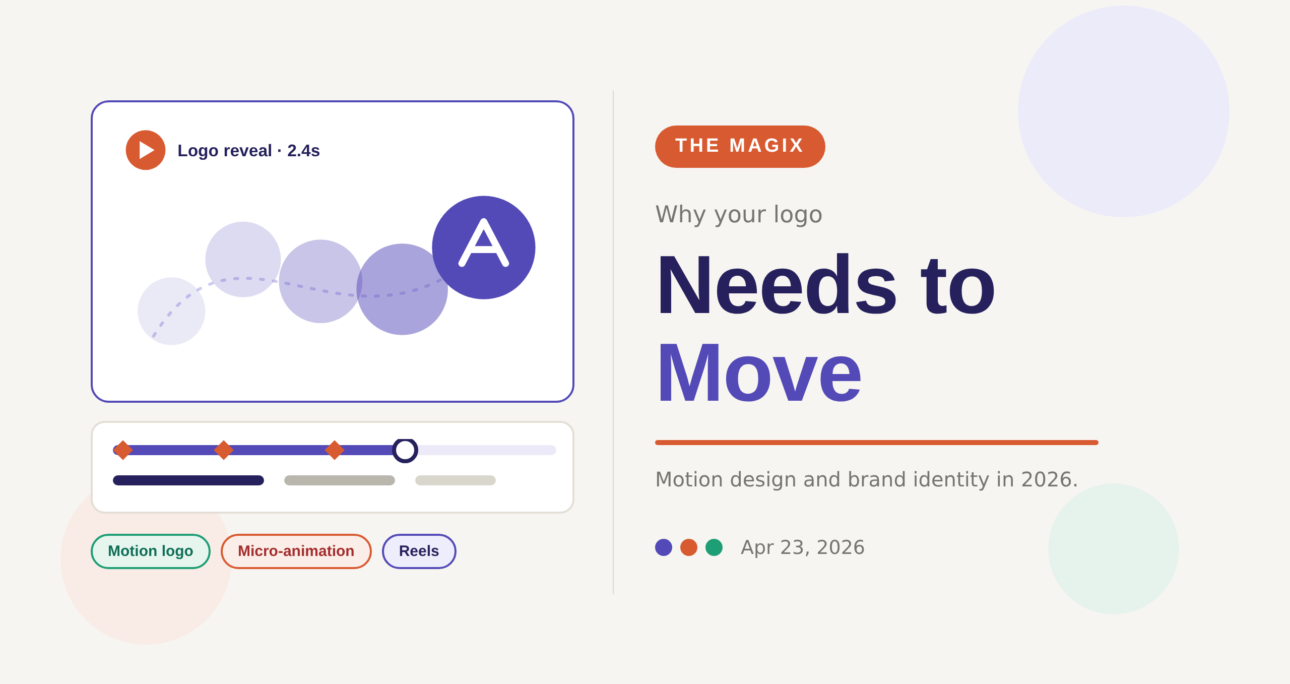
A motion logo is an animated version of your static logo — one that plays as a short intro when your brand appears on video content, social media, or digital presentations. Think of the Netflix N, the HBO static, or the Disney castle. These aren’t just pretty animations. They’re brand memory triggers.
In 2026, with short-form video dominating every platform — Instagram Reels, YouTube Shorts, LinkedIn video — a motion logo is no longer a nice-to-have for large brands. It’s a practical tool for any business that creates video content.
Why Motion Is Now Part of Brand Identity
Brand identity used to live primarily in static formats: business cards, letterheads, signage, print ads. Today, a brand lives primarily on screens — and screens are moving by default. A static logo in a world of animated interfaces feels like a photograph in a cinema.
Motion gives a brand rhythm, personality, and presence in a way that static design simply cannot achieve. The way a logo reveals itself — does it bounce in playfully, or slide in with precision, or dissolve in gently — communicates character before a single word is spoken.
Micro-Animation: The Smaller Motion Opportunity
Motion design in branding isn’t just about animated logos. Micro-animations — the small, intentional movements within a website or app — are increasingly part of how brands communicate quality and attention to detail.
A button that responds when you hover. An image that subtly shifts as you scroll past. A form that gently confirms your submission. These micro-interactions are invisible when they work perfectly — but their absence is felt. Websites with thoughtful micro-animation feel more polished, more trustworthy, and more premium than those without.
Do Small Businesses Actually Need This?
The honest answer: if you’re creating video content regularly — which I’d argue every business should be in 2026 — then yes, a motion logo is worth having. It takes less than a second to play, it reinforces your brand at every video touchpoint, and it signals professionalism to an audience that increasingly knows what polished looks like.
If you’re not yet creating video content, focus on that first. The motion logo will matter more once you’re publishing.
Where to Start
The starting point is always a strong static logo — one that’s built as a proper vector file with clean, separated elements. A logo designed with motion in mind from the start is significantly easier and cheaper to animate later. This is one of the reasons I build brand identity systems at The Magix with future motion use in mind, even when the client isn’t ready for it yet.
From a well-built logo, a simple motion version — a clean reveal animation — is very achievable. The logo doesn’t need to do cartwheels. It just needs to arrive with intention.
📩 Ready to build a brand identity built for 2026? Let’s talk