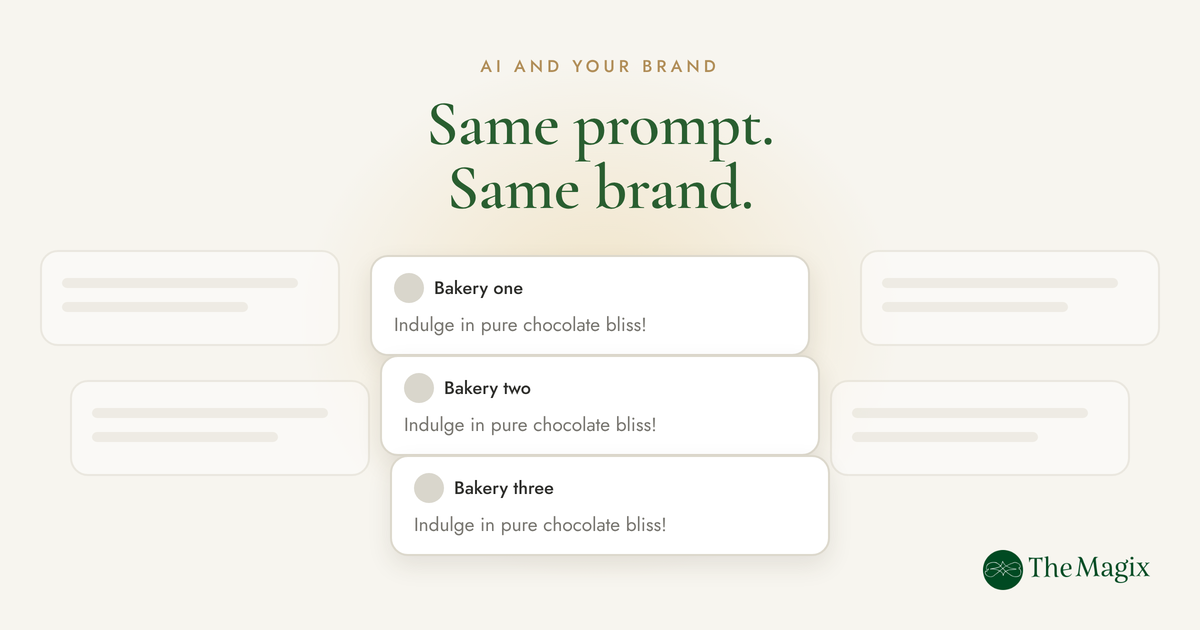
Ask an AI tool to write an Instagram caption for a bakery, and it will give you a good caption. Ask it for three more bakeries, and it will give you the same caption three times with the name changed. The tool is not broken. The prompt is. When the instruction is vague, the answer is the most average one the tool can find, and the average is exactly what every other business is also posting.
This post takes three everyday kinds of prompts, for a caption, a homepage headline and a logo, and shows what a vague version produces and what changes when the prompt carries something only that business could say.
Why AI content all starts to look the same
AI writing tools work by predicting the most likely next words. Give them a short, general instruction and they return the most likely answer to it, which is the answer that sits in the middle of everything they have read. Image tools do the same with pictures.
Now picture thousands of businesses using the same few tools with the same short prompts. They all receive the middle. That is why so many captions open with “indulge”, so many websites promise to “elevate” something, and so many new logos are a blue gradient with a swoosh.
To test it, the same one-line prompt went into two new Gemini chats, with only the bakery name changed: “Design a portrait poster for my bakery, [name], announcing our new chocolate cake.” Both bakery names are made up. This is what came back.
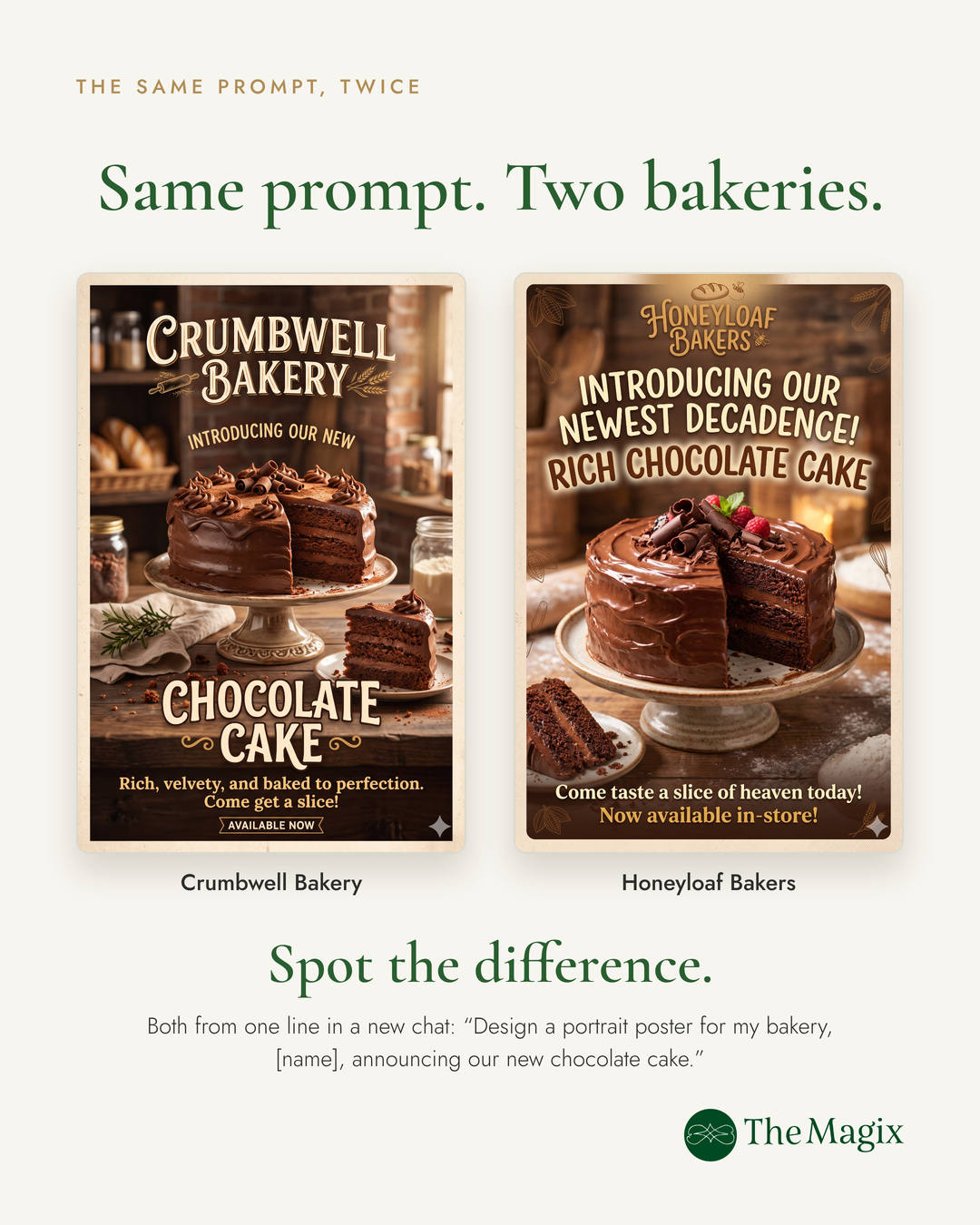
The same wooden table, the same three-layer cake with a slice cut out, the same cream lettering opening with “Introducing our new”. Only the names change.
Customers do not need to know any of this to notice it. They simply stop remembering who said what. If your post could carry any logo in your category, it is helping the category, not you.
Example 1: an Instagram caption
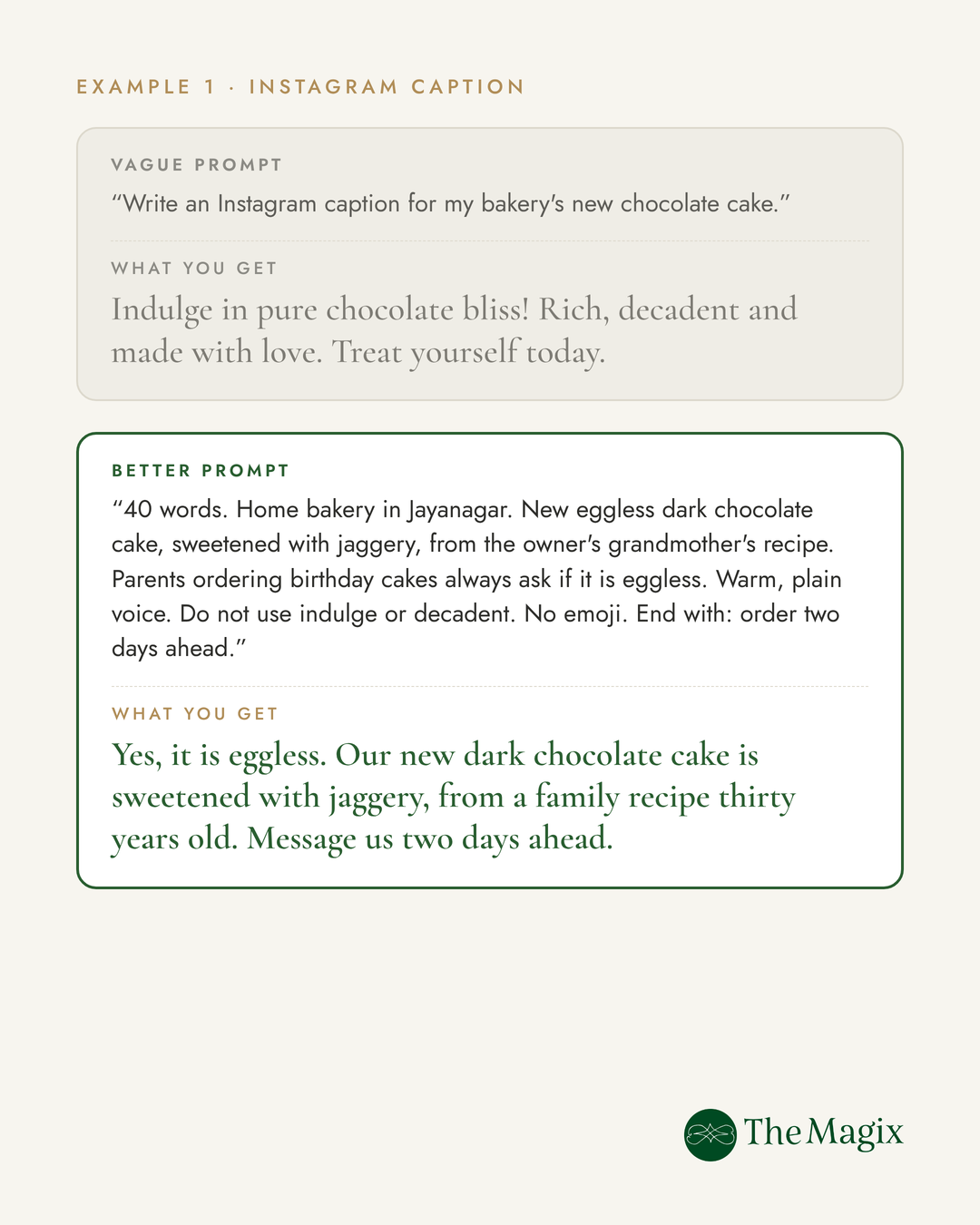
The vague prompt
Write an Instagram caption for my bakery’s new chocolate cake.
What it usually gives you
Indulge in pure chocolate bliss! Our new chocolate cake is rich, decadent and made with love. Treat yourself today. #ChocolateLovers #BakeryLife
Nothing in it is wrong, and nothing in it belongs to this bakery. Any bakery in any city could post it tomorrow.
A better prompt
Write a 40 word Instagram caption for a home bakery in Jayanagar, Bengaluru. New this week: an eggless dark chocolate cake sweetened with jaggery, from the owner’s grandmother’s recipe. Most orders are birthday cakes from parents, and the first question is always whether it is eggless. Voice: warm and plain, like a neighbour. Do not use indulge, decadent, bliss or treat yourself. No emoji. End by asking them to order two days ahead.
What it gives you
Yes, it is eggless. Our new dark chocolate cake is sweetened with jaggery, from a recipe that has been in the family for thirty years. Most of ours go to birthday tables, so every cake is baked to order. Message us two days ahead.
The second caption answers the question customers actually ask, says something no other bakery can say, and tells people what to do next.
Example 2: a homepage headline
The vague prompt
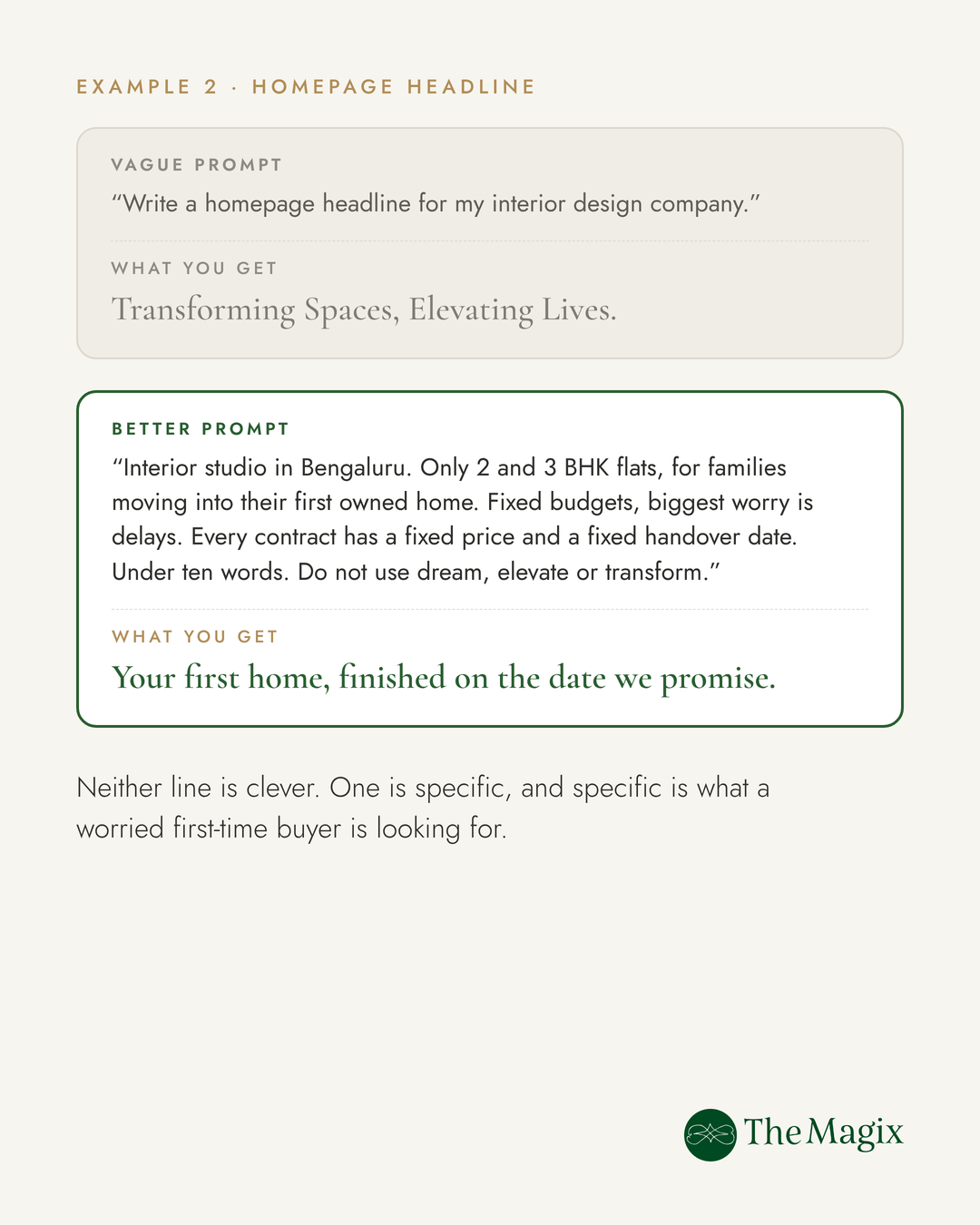
Write a homepage headline for my interior design company.
What it usually gives you
Transforming Spaces, Elevating Lives.
It is the kind of line that could sit on any studio’s website, which is the problem.
A better prompt
Write five homepage headlines for an interior design studio in Bengaluru that only does 2 and 3 BHK apartments for families moving into their first owned home. Clients have a fixed budget and their biggest worry is delays. The studio writes a fixed price and a fixed handover date into every contract. Under ten words each. Do not use dream, elevate or transform.
What it gives you
Your first home, finished on the date we promise.
2 and 3 BHK interiors. Fixed price. Fixed handover.
Neither line is clever. Both are specific, and specific is what a worried first-time buyer is looking for.
Example 3: a logo or brand image
The vague prompt
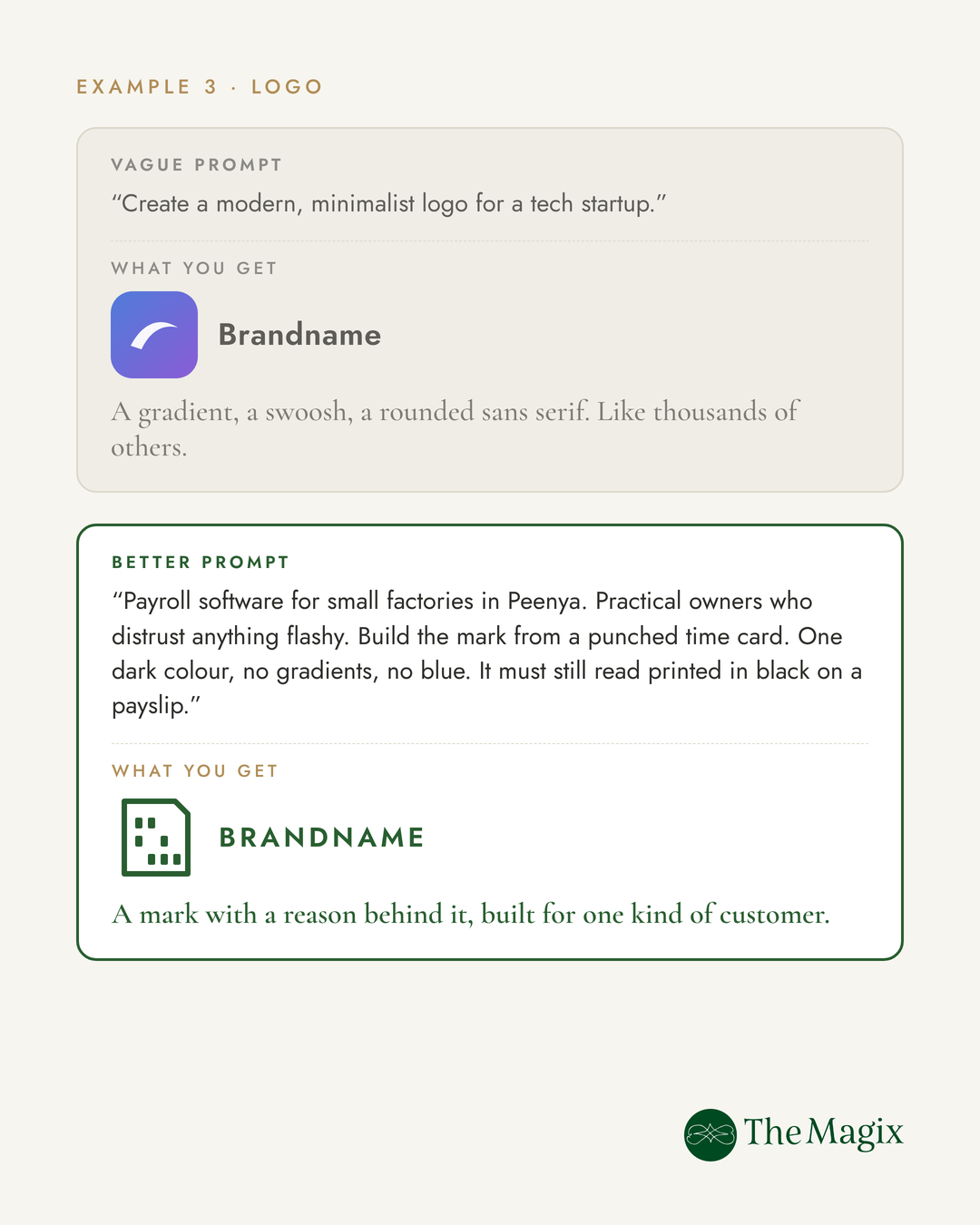
Create a modern, minimalist logo for a tech startup.
What it usually gives you
A blue to purple gradient, an abstract swoosh or hexagon, and the name in a rounded sans serif. It looks fine. It also looks like thousands of other logos, because it is built from the average of them.
A better prompt
A logo concept for payroll software used by small factories in Peenya. The owners are practical and distrust anything flashy. Build the mark from the idea of a punched time card. One dark colour only, no gradients, no swooshes, no blue. It must still read when printed in black on a payslip.
What it gives you
A direction with a reason behind it: a simple mark that belongs to one kind of customer. Treat it as a starting sketch. A logo still has to be designed properly so it works at every size, on every surface, and holds together with the rest of the brand.
What a good prompt carries
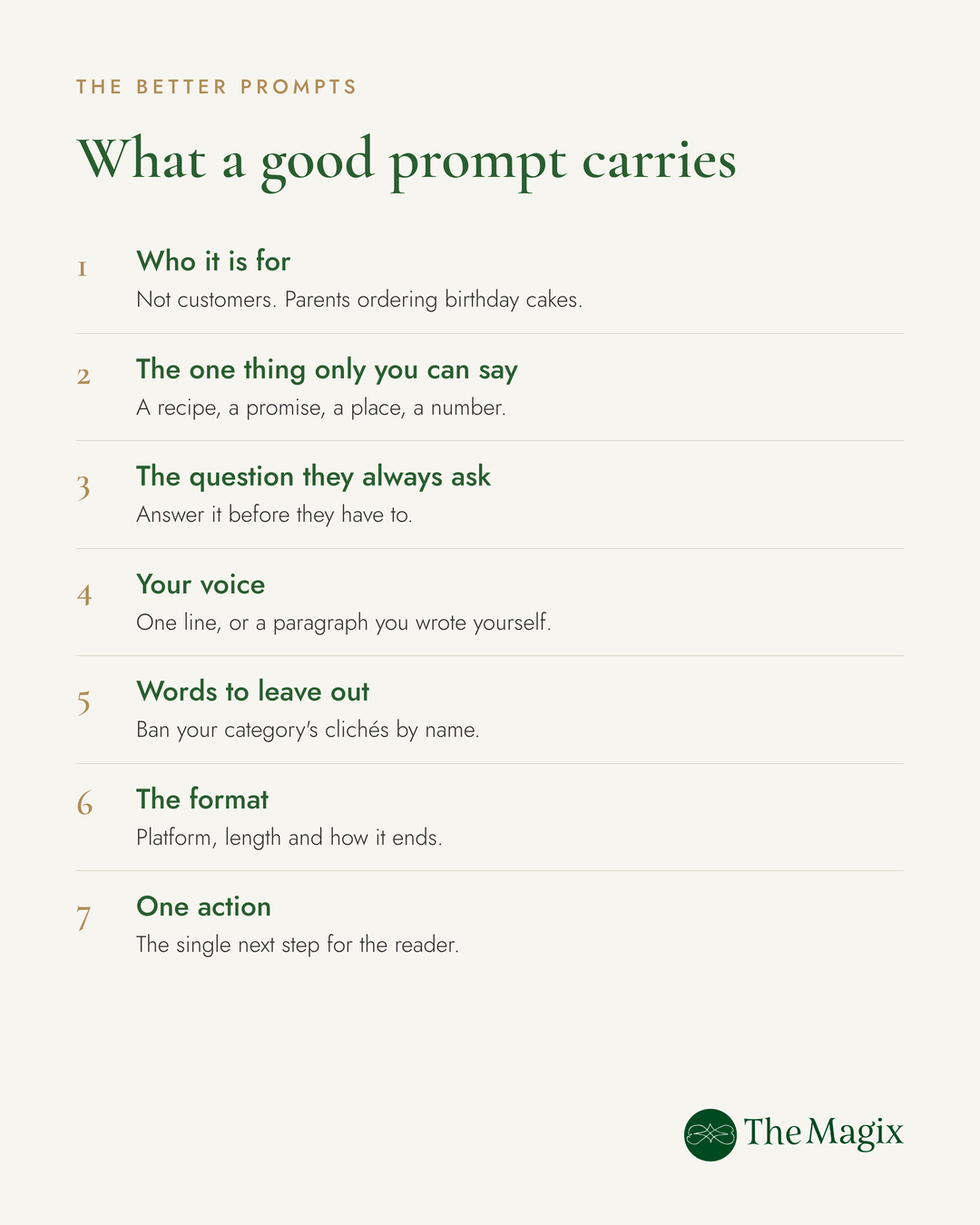
Look at the three better prompts again. None of them is long or technical. Each one carries the same seven things:
- Who it is for. Not “customers”, but parents ordering birthday cakes, or families buying their first flat.
- The one thing only you can say. A recipe, a promise in the contract, a place, a number.
- The question your customers actually ask. Answer it before they have to.
- Your voice. Describe it in a line, or paste a paragraph you wrote yourself and ask the tool to match it.
- Words to leave out. Ban the clichés of your category by name.
- The format. Platform, length, and how it should end.
- One action. The single next step you want the reader to take.
A prompt you can copy
Write a [format and length] for [platform]. The business: [what you do, where, for whom]. The reader: [who they are and what they worry about]. What only we can say: [your fact, promise, story or number]. The question they always ask: [question]. Voice: [one line, or paste a sample of your own writing]. Do not use: [your category’s clichés]. End with: [the one action].
Fill in the brackets once, keep the answers in a note, and you will never start from a blank prompt again.
What the prompt cannot do for you
Every better prompt above depends on answers the business already had: who it serves, what it promises, how it sounds. A tool can write faster than anyone. It cannot decide what your business stands for. If those answers are not written down, every prompt starts from a guess, and the guess is the average again.
That is the part worth spending time on. Once your positioning and voice are clear, AI becomes a useful assistant instead of a way to sound like everybody else.
If your brand voice has never been written down, that is where The Magix starts. Book a free introductory call: https://the-magix.com/
Questions people ask
Why does AI-written content sound the same?
Because a short, general prompt returns the most likely answer, and the most likely answer is the one in the middle of everything the tool has learned from. When many businesses use the same tools with similar prompts, they receive similar results.
Is it wrong to use AI for brand content?
No. It is a fast way to draft, rework and adapt content. The problem starts when the prompt carries nothing specific about the business, so the output could belong to anyone.
What should a prompt for brand content include?
Who the content is for, the one thing only your business can say, the question customers ask, your voice, the words to avoid, the format, and the one action you want the reader to take.
Can AI create a brand voice for me?
It can imitate a voice once you describe it or show it samples of your writing. Deciding what your brand sounds like, and why, comes from knowing your customers and your business, and that is work for people.